"Layers of the Present" - Waste Into Art - Recycled Exhibition / Aurelie Cornaz & Urangoo Ider

Updated: Feb 4
Zanabazar Museum of Fine Arts, Mongolia, 2026 / January - February
I believe that art can bring us at least a single drop closer to awareness. Art does not have to speak about happiness; on the contrary, it often leads us to understanding through suffering, mistakes, and imperfection. One can learn and gain insight from anything. This exhibition is not merely an experiment with material; it is a quiet space that articulates the luxury of being wise through art.
A wise attitude distances us from suffering and brings us, at the very least, closer to a sense of calm. A lack of wisdom, however, harms both ourselves and others. Wisdom does not arrive suddenly—it is gradually formed through lived experience, mistakes, endurance, or reasons beyond our understanding. One of these immeasurable sources is undoubtedly art.
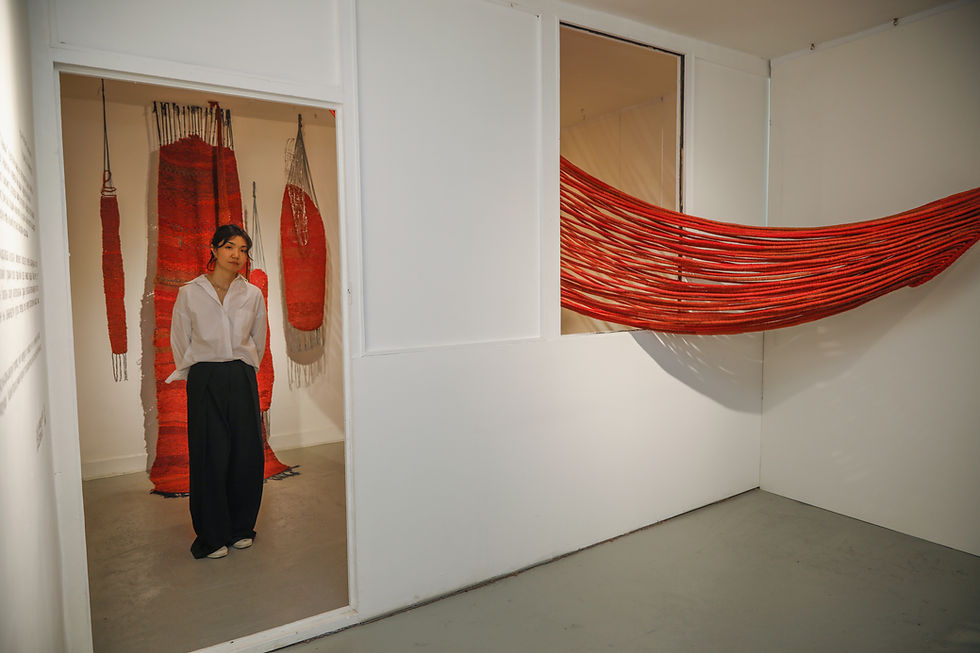
In this exhibition, wisdom is not expressed through loud slogans or grand messages, but through material choices, repetitive labor, and the rhythms of everyday life. Recycled paper—commonly perceived as waste, something temporary and undervalued—becomes the primary language of artistic expression here.
For Aurelie (Uka), paper is not merely a raw material. She carries it with her, gathers it everywhere, breaks it down, and allows it to be reborn. Infused with elements such as plants, ash, and soil, the surfaces of these papers resemble geological cross-sections—rough, fragile, and layered. Rather than inviting the viewer simply to “look,” they call for silent sensing. There is no ornamentation here; instead, the traces of sustained labor and patience remain clearly visible.
Upon this material foundation, Urangoo weaves her own artistic thinking, observation, and inner rhythm. Her decision to distance herself from the noise and pace of the capital and shortly settle into the quiet environment of the countryside seems directly reflected in her work. Her artworks are sharp and perceptive, yet never loud. Instead, they gently articulate everyday life, ethical awareness, and a natural sensibility through a refined artistic language.
Urangoo is not merely an inventor, but, in the fullest sense, an artist and an educator. Her lifestyle, speech, actions, and creative practice align in a single direction, appearing as an embodiment of her human values. Each work is simple yet powerful—silent, yet questioning.
The drawings, assemblages, and mixed-media works presented in the exhibition go beyond using recycled paper as a mere base material. They function as an archive of time, error, and unrepeatable moments. As Urangoo reflects on her drawings:
“Every day has a different color… Mistakes are steps toward success. A mistake itself is also success. My drawings are diaries written truthfully, together with their mistakes.”
This statement encapsulates the exhibition’s central axis.
Each day may have a different color, yet all are part of a singular, unrepeatable flow of moments. A moment may belong to the past or the future—time here is not linear, but layered. Now, this very moment, is what is precious.
We often hear phrases such as “reduce waste” or “use materials responsibly.” Yet this exhibition avoids promotional language or trend-driven slogans. Instead, it expresses these ideas through lived attitude and artistic practice. The viewer is inevitably led to ask: How am I relating to objects, to life, to this very moment?
In the end, what matters most is this: the exhibition does not teach wisdom—it allows it to be felt. This unrepeatable, precious moment—the quiet pause that emerges within the viewer—is wisdom itself.
I felt it.
Through art, awareness appeared in this moment like a constellation, quietly reaching the heart.
Ulziibat Enkhtur
Art Review Writer


Comments